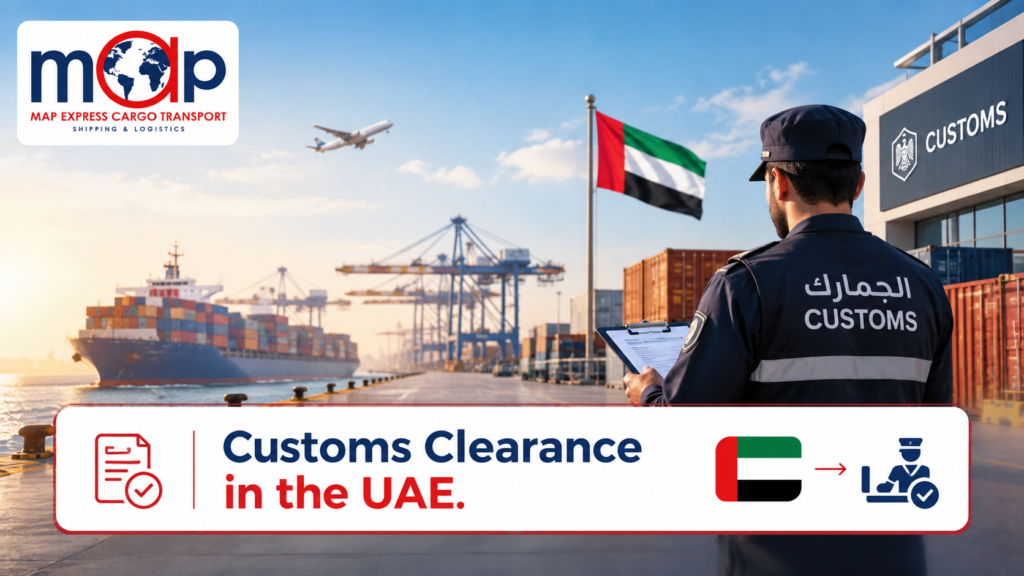
Customs Clearance in the UAE
Customs clearance is an essential part of importing and exporting goods through the United Arab Emirates (UAE). Whether you are shipping commercial products, personal belongings, furniture, or industrial equipment, understanding the customs process can help you prepare the necessary documents and reduce avoidable delays.
Customs procedures may vary depending on the type of goods, their origin and destination, the applicable customs authority, and the transportation method. Certain products may also require permits, certificates, inspections, or additional approvals before they can be released.
In this practical guide, we explain how customs clearance in the UAE generally works, which documents importers and exporters may need, what factors can affect the process, and how to prepare a shipment for customs review.
Looking for a Reliable Shipping Solution from the UAE?
MapExpress Cargo offers reliable air, sea, and land freight services for individuals and businesses, with support for customs procedures and international shipping requirements.
What Is Customs Clearance?
Customs clearance is the process through which goods are declared to the relevant customs authority and assessed for compliance with applicable import or export requirements.
Depending on the shipment, the process may include submitting a customs declaration, providing supporting documents, verifying the cargo details, assessing applicable duties and taxes, and completing any required inspections or approvals.
Once the relevant requirements have been fulfilled and the shipment is authorized for release, the goods can proceed to the next stage of transportation or delivery.
Customs clearance may be required for several types of shipments, including:
Commercial products and merchandise.
Personal belongings and household furniture.
Machinery, equipment, and spare parts.
Vehicles and automotive components.
Raw materials and industrial supplies.
Goods moving through the UAE for onward transportation, where applicable procedures require customs processing.
The requirements for each shipment depend on its specific circumstances.
How Does Customs Clearance Work in the UAE?
Although the exact process can differ, customs clearance generally involves several key stages.
1. Identify the Applicable Customs Procedure
The first step is to determine how the shipment will enter, leave, or move through the UAE.
Importing goods into the UAE mainland, exporting goods from the country, moving cargo through a free zone, and transporting goods under a transit arrangement may involve different procedures.
The destination, cargo classification, commercial purpose, and applicable customs authority should be established before preparing the declaration.
2. Prepare the Shipment Documents
The importer, exporter, or appointed customs representative should gather the documents relevant to the shipment.
Common documents may include a commercial invoice, packing list, transport document, certificate of origin, and customs declaration details. Additional documents may be required depending on the product and applicable regulations.
The information should be consistent across the documents, especially the description of the goods, quantities, declared values, and parties involved in the transaction.
3. Submit the Customs Declaration
The customs declaration provides the relevant authority with information about the goods and their movement.
Depending on the procedure, the declaration may be submitted electronically through the applicable customs system by the importer, exporter, or an authorized customs representative.
Incorrect information, missing fields, or inconsistent documents may lead to requests for clarification or additional processing.
4. Complete Any Required Assessment or Inspection
Customs authorities may review the declaration and supporting documents. A shipment may also be selected for physical inspection or other verification.
The type and extent of checks depend on the shipment, applicable regulations, and the decisions of the relevant authorities.
If additional information, permits, or inspections are required, the shipment may need to remain on hold until the requirements are completed.
5. Settle Applicable Duties, Taxes, and Charges
Depending on the transaction, customs duties, import VAT, or other applicable charges may need to be settled before the goods can be released.
The amount payable depends on factors such as the product classification, customs value, origin, destination, and applicable exemptions or trade arrangements.
Customs duties and taxes are separate from many transportation and handling charges. Confirm which costs are included in your freight quotation and which are payable separately.
6. Obtain Release and Arrange Delivery
Once the relevant declaration, documentation, approvals, inspections, and payments have been completed, the shipment may be released according to the applicable customs procedure.
The cargo can then proceed to collection, onward transportation, or final delivery, subject to any remaining port, terminal, carrier, or delivery requirements.
Documents Required for Customs Clearance in the UAE
Preparing the correct documents before shipping can help make customs processing more organized. Not every document is required for every shipment, so the list should be checked against the specific cargo and customs procedure.
Commercial Invoice
A commercial invoice records the transaction between the seller and buyer. It commonly includes:
Seller and buyer details.
Description of the goods.
Quantities and unit prices.
Total declared value and currency.
Country of origin, where applicable.
Relevant shipment or transaction references.
The invoice should accurately describe the goods and reflect the transaction details. Vague descriptions may lead to questions about the product classification or declared value.
Packing List
A packing list explains how the shipment is packed and identifies its contents. It may include:
Number of packages or cartons.
Description of the items.
Quantities and packaging details.
Net and gross weights, where relevant.
Dimensions or package identification numbers.
For furniture and personal belongings, a detailed inventory can help identify individual items. The format and information required should match the shipment’s customs procedure.
Bill of Lading or Air Waybill
The transport document depends on the shipping method.
A bill of lading is commonly used for sea freight, while an air waybill is used for air cargo. Road shipments use the relevant road transport documentation.
These documents contain information about the cargo movement, the parties involved, and the transportation arrangement. Ensure that the shipment details are consistent with the commercial and customs documents.
Certificate of Origin
A certificate of origin identifies the country where goods originate, subject to the applicable rules of origin.
It may be requested by customs authorities or required to support a preferential tariff claim or another regulatory requirement. Whether it is necessary, and which form is acceptable, depends on the goods, trading partners, and applicable arrangements.
Customs Declaration and Importer or Exporter Details
A customs declaration contains information needed to process the shipment under the relevant customs procedure.
The responsible party may also need to provide applicable importer or exporter registration details, customs codes, licenses, or other business documentation required by the relevant authority.
Requirements can differ between customs authorities and transaction types. Confirm the applicable registration and declaration requirements before the cargo arrives.
Permits and Product-Specific Certificates
Certain goods may require additional permits, certificates, or approvals from the relevant government or regulatory authority.
Examples may include food products, pharmaceuticals, medical equipment, chemicals, telecommunications equipment, plants, and other regulated goods. The exact requirements depend on the product, its intended use, and current regulations.
Some goods may be restricted or prohibited from import or export. Confirm whether the cargo is permitted and whether prior approval is required before arranging shipment.
Customs Clearance for Imports into the UAE
Importing goods into the UAE involves identifying the applicable import procedure and preparing the documentation required by the relevant customs authority.
The process can vary according to whether goods are entering the mainland, moving into or out of a free zone, or being imported under another customs arrangement.
Importers should consider the following points before dispatching their cargo.
Confirm the product classification. Goods must be classified under the applicable customs tariff system. The classification can influence duty rates, restrictions, and permit requirements.
Check the customs value. The value used for customs purposes must be determined according to the applicable valuation rules. It may not always be identical to the price shown on a freight quotation.
Verify the country of origin. Origin information can be relevant to documentation, trade measures, and eligibility for any applicable preferential treatment.
Check permits and restrictions. Confirm whether the product requires regulatory approval or is subject to special import conditions.
Prepare consistent documents. Review the invoice, packing list, and transport document to ensure the shipment details match.
Importers should confirm current requirements with the relevant UAE customs authority or a qualified customs representative before shipping.
Customs Clearance for Exports from the UAE
Exporting goods from the UAE also requires compliance with the applicable customs procedures and any rules governing the goods and destination country.
Before dispatch, exporters should verify:
Whether the goods can legally be exported.
Which export declaration and supporting documents are required.
Whether an export permit or certificate is necessary.
Whether the destination country has additional import restrictions.
Whether the invoice and packing list accurately describe the cargo.
Whether the transportation and delivery arrangements are confirmed.
Export customs clearance in the UAE does not automatically mean the goods will be cleared for import at their destination. The receiving country may have separate documentation, duties, taxes, product standards, and inspection requirements.
For international shipments, both the UAE export requirements and the destination country’s import requirements should be considered during planning.
Customs Clearance for Personal Belongings and Furniture
Personal belongings and household furniture may be subject to different procedures from ordinary commercial shipments, depending on the circumstances.
For example, a person relocating to another country may need to provide a detailed inventory and documents supporting the shipment’s purpose. The destination country may also apply conditions concerning used household goods, residency status, eligibility for relief, or restricted items.
Before shipping personal effects, prepare a clear inventory that identifies the contents of each package. Avoid using descriptions such as “miscellaneous items” when more specific information is available.
Check whether the destination requires additional documents, such as proof of residence, identification, a visa or residency document, or a declaration relating to household goods. These requirements vary by country and shipment type.
Used personal belongings should not automatically be assumed to qualify for duty-free entry. Eligibility depends on the applicable rules and the individual’s circumstances.
If you are shipping furniture or household items internationally, allow time to verify both the UAE procedures and the import requirements at the destination.
Customs Clearance for Commercial Cargo
Commercial shipments may involve additional considerations related to product classification, valuation, origin, licensing, and regulatory compliance.
Businesses should ensure that their shipment documents accurately reflect the transaction and the physical cargo.
Important preparation steps include:
Confirming the correct tariff classification for each product.
Reviewing the commercial invoice and declared value.
Checking whether the goods require permits or conformity documents.
Verifying the origin information and any applicable certificates.
Ensuring that quantities and descriptions match the packing list.
Coordinating the customs process with the freight and delivery schedule.
For shipments containing multiple products, different product categories may have different documentation or approval requirements. A detailed itemized invoice and packing list can make it easier to identify the requirements for each category.
Businesses should also establish who is responsible for customs declarations, duties, taxes, and other clearance-related charges under the agreed shipping terms.
What Can Delay Customs Clearance?
Customs clearance times are not the same for every shipment. Some cargo may be processed relatively quickly, while other shipments require additional review, documents, inspections, or approvals.
Common causes of delays include:
Incomplete Documentation
Missing invoices, packing lists, permits, or other required documents can prevent the clearance process from moving forward.
Inconsistent Shipment Details
Differences between the invoice, packing list, transport document, and customs declaration may lead to requests for clarification.
Incorrect Product Classification
An incorrect or unclear tariff classification can affect the assessment of duties and the identification of applicable controls.
Missing Permits or Regulatory Approvals
Goods that require special authorization may not be released until the relevant approval is obtained.
Customs Inspection
A customs authority may select cargo for inspection or additional verification. The time needed depends on the nature of the inspection and the circumstances of the shipment.
Outstanding Payments or Other Charges
Unsettled duties, taxes, terminal charges, or other applicable fees may prevent the shipment from proceeding to collection or delivery.
Destination-Country Requirements
For exports, missing information required by the receiving country may cause problems after the goods leave the UAE.
To reduce avoidable delays, prepare documents early, confirm product requirements, and coordinate with the freight forwarder or customs representative before dispatch.
How Much Does Customs Clearance Cost in the UAE?
There is no single customs clearance cost that applies to every shipment. The total amount depends on the goods, their value and classification, the customs procedure, and the services required.
Potential cost components include:
Applicable customs duties.
Import VAT or other applicable taxes.
Customs declaration or clearance service fees.
Port, terminal, or cargo handling charges.
Inspection-related costs, where applicable.
Storage or demurrage charges if cargo remains at a facility beyond the permitted or agreed period.
Permit, certificate, or other regulatory processing costs.
These charges are not all government customs fees. Some are levied by carriers, terminals, service providers, or other parties involved in handling the shipment.
The applicable duty and tax treatment should be checked against the current rules for the specific product and transaction. Do not assume that the same rate or exemption applies to every category of goods.
When requesting a freight or customs quotation, ask for a breakdown of included services, expected third-party charges, and costs that may arise if additional inspections or storage are required.
Tips for Smoother Customs Clearance
Good preparation can make the process more predictable, although it cannot guarantee a specific clearance time or outcome.
Start preparing early. Gather invoices, packing lists, transport documents, and permits before the cargo is dispatched.
Use accurate descriptions. Describe products clearly, including their type, material, purpose, and model details where relevant.
Check the tariff classification. Seek professional guidance if the classification is uncertain or the goods may be subject to special controls.
Verify product restrictions. Confirm that the goods are permitted and identify any approvals required before shipping.
Keep documents consistent. Ensure that quantities, values, weights, and shipment references match across the applicable records.
Understand the agreed shipping terms. Confirm who is responsible for customs declarations, duties, taxes, and clearance-related charges.
Check destination requirements. For international shipments, prepare for the import rules of the receiving country as well as the UAE export procedure.
Work with an experienced logistics provider. A freight forwarder or customs representative may help coordinate documents and transport arrangements, subject to the services they provide and the applicable authorization requirements.