Choosing Between Air, Sea, and Road Freight
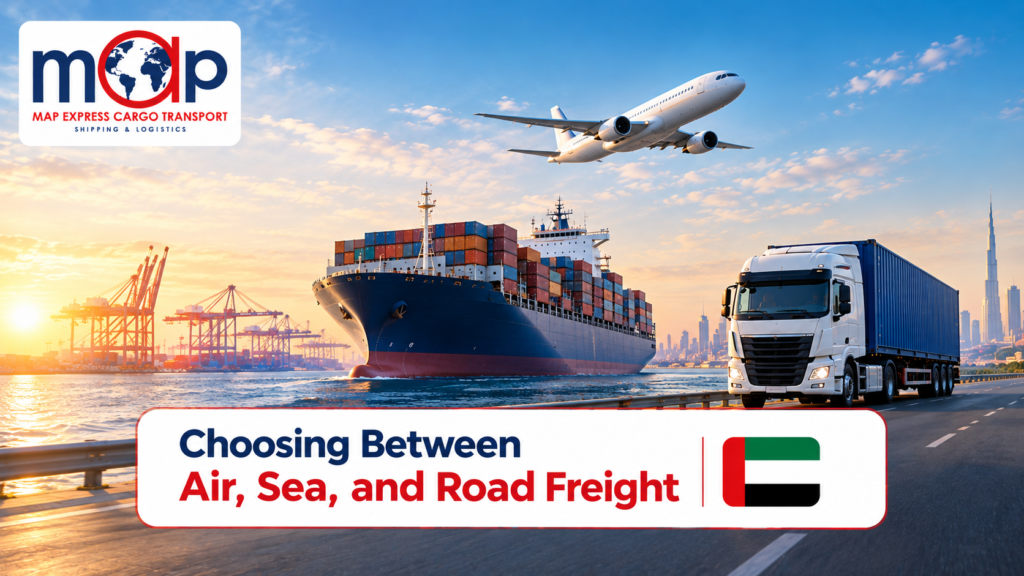
Choosing the right freight method is an important part of planning an international shipment. Air freight, sea freight, and road freight each offer different advantages depending on the cargo, destination, delivery schedule, budget, and handling requirements.
For some shipments, speed is the main priority. For others, transporting large volumes of goods economically or arranging flexible regional delivery may be more important. Understanding how each method works can help businesses and individuals make informed shipping decisions.
In this guide, we compare air, sea, and road freight, explain the factors to consider when selecting a shipping method, and provide practical examples to help you identify a suitable option for your cargo.
Looking for a Reliable Shipping Solution from the UAE?
MapExpress Cargo offers reliable air, sea, and land freight services for individuals and businesses, with support for customs procedures and international shipping requirements.
What Are Air, Sea, and Road Freight?
Freight refers to the transportation of goods from one location to another. The main difference between air, sea, and road freight is the mode of transport used to move the cargo.
Air freight transports goods by aircraft. It is often considered when shipment speed is important, particularly for urgent, time-sensitive, or relatively high-value cargo.
Sea freight transports goods by cargo vessel. It is commonly used for large shipments, heavy cargo, commercial goods, furniture, and containerized freight moving between ports.
Road freight transports goods using trucks and other road vehicles. It is widely used for domestic transportation and cross-border shipments between countries connected by road routes.
The most suitable option depends on the complete shipping requirement rather than the transportation method alone. Pickup, customs clearance, handling, transfer between transport modes, and final delivery can all influence the overall result.
Air Freight: When Speed Matters
Air freight is often selected when goods need to travel internationally within a relatively short timeframe. It can be suitable for shipments where delays would affect business operations, product availability, or delivery commitments.
Advantages of Air Freight
Faster transportation for many international routes
Aircraft can cover long distances faster than cargo vessels or road vehicles travelling across comparable distances. However, the total shipment time also includes collection, export procedures, airport handling, customs clearance, and final delivery.
Suitable for urgent cargo
Air freight may be appropriate for urgent documents, selected spare parts, samples, electronics, and other goods that need prompt transportation, subject to applicable restrictions.
Useful for smaller or time-sensitive shipments
For some shipments, the value of faster delivery can justify the higher transportation cost compared with other freight methods.
Access to international destinations
Air cargo networks connect many international markets through commercial airports and cargo hubs, although routing and service availability vary by destination.
Disadvantages of Air Freight
Higher transportation costs for many shipments
Air freight is often more expensive than sea freight for large or heavy consignments. Charges may depend on both actual weight and volumetric weight.
Weight and size limitations
Aircraft capacity, packaging dimensions, cargo type, and airline restrictions can affect whether a shipment can be accepted and how it must be prepared.
Restrictions on certain goods
Batteries, chemicals, liquids, dangerous goods, and other regulated items may require special documentation, packaging, approvals, or a specific handling arrangement. Some items may not be accepted.
Additional handling and processing time
Although the flight itself may be relatively short, airport procedures and customs processing still contribute to the overall delivery schedule.
When Should You Choose Air Freight?
Consider air freight when:
Your cargo is time-sensitive.
You are shipping relatively small quantities of valuable goods.
A delayed delivery could interrupt business operations.
You need to transport urgent spare parts or product samples.
The faster service justifies the total shipping cost.
For example, a business shipping replacement components needed to restore equipment may prioritize air freight to reduce downtime. The final choice should still account for cargo acceptance, routing, and the complete door-to-door schedule.
Sea Freight: When Capacity and Shipment Volume Matter
Sea freight is widely used for international commercial shipments, containerized cargo, furniture, machinery, and other goods that can be transported by vessel.
It is particularly relevant when shipment volume is substantial and the delivery schedule allows for a longer transportation process.
Advantages of Sea Freight
Suitable for large and heavy cargo
Ships can carry large quantities of goods, making sea freight a practical option for many bulk shipments, industrial products, furniture, and commercial consignments.
Container options for different shipment sizes
Businesses can consider Full Container Load (FCL) or Less than Container Load (LCL), depending on the quantity of cargo and the available service.
FCL generally involves reserving a container for one shipment, while LCL allows compatible shipments from different customers to share container space. Availability and suitability depend on the route and cargo requirements.
Useful for planned international shipments
Sea freight can be appropriate for inventory replenishment, business supplies, relocation cargo, and other shipments where the delivery schedule can accommodate sea transportation and associated handling.
Potentially economical for larger volumes
For many routes, sea freight can offer a lower transportation cost per unit of cargo than air freight, especially for large shipments. However, port charges, inland transport, handling, and other fees must be included when comparing total costs.
Disadvantages of Sea Freight
Longer overall transit times
Sea freight usually takes longer than air freight for comparable long-distance international movements. Port schedules, transshipment, customs procedures, and inland delivery can also affect the overall timeline.
Port and handling requirements
Cargo may need to be transported to a port, handled at a terminal, and collected or delivered after arrival. These stages can add time and cost.
Additional charges beyond ocean freight
The quoted sea freight rate may not include every cost associated with a shipment. Depending on the arrangement, charges may include terminal handling, documentation, customs clearance, storage, and inland transportation.
Not ideal for every urgent shipment
When a delivery is needed quickly, the longer overall process may make sea freight unsuitable unless the shipping schedule can accommodate it.
When Should You Choose Sea Freight?
Consider sea freight when:
You are shipping large or heavy consignments.
Your cargo can accommodate a longer delivery schedule.
You are moving furniture or household belongings internationally.
You are transporting commercial inventory or machinery.
Container capacity and overall shipping economics are important.
For example, a company importing a planned stock of furniture may prefer sea freight because the shipment volume is substantial and the goods are not required immediately.
Road Freight: When Regional Connectivity Matters
Road freight is commonly used for shipments within a country and between neighboring countries connected by road networks. It can also form part of a larger international logistics arrangement that combines road transportation with sea or air freight.
For shipments from the UAE to other Gulf Cooperation Council (GCC) countries, road freight may be worth considering, depending on the destination, route, border requirements, and available services.
Advantages of Road Freight
Flexible pickup and delivery arrangements
Trucks can often collect cargo from a warehouse, business premises, or other accessible location and deliver it to a specified destination, subject to the service arrangement and local access conditions.
Useful for regional transportation
Road freight can be practical for cross-border shipments between connected markets, particularly when the distance and border procedures make road transportation suitable.
Different vehicle and load options
Depending on the provider and route, cargo may move in a dedicated vehicle, a shared load, or a vehicle configured for particular goods.
Useful for door-to-door logistics
Road transport can reduce the need for separate local collection and delivery arrangements when suitable pickup and delivery services are available.
Disadvantages of Road Freight
Dependent on road and border conditions
Traffic, weather, road restrictions, border queues, inspections, and documentation issues can affect the journey.
Route and distance limitations
Road freight is most practical where a suitable road network connects the origin and destination. It is not a direct substitute for air or sea freight when shipping to destinations without a viable road connection.
Vehicle capacity limitations
A truck has finite weight and volume capacity. Oversized, unusually heavy, hazardous, or specialized cargo may require a particular vehicle or additional arrangements.
Cross-border compliance requirements
International road shipments may require customs declarations, transport documents, permits, and other paperwork depending on the countries involved and the nature of the goods.
When Should You Choose Road Freight?
Consider road freight when:
You are shipping between locations connected by suitable road routes.
Your destination is within the UAE or a neighboring market.
Flexible collection and delivery are important.
Your cargo fits the available vehicle capacity.
The delivery schedule and border requirements are compatible with road transportation.
For example, a business moving palletized products from the UAE to a customer in a neighboring GCC country may consider road freight, subject to the route, customs requirements, and transport arrangements.
Air vs. Sea vs. Road Freight: The Main Differences
The best method depends on how your shipment will be transported, the distance involved, the cargo characteristics, and the required delivery arrangement.
Speed and Delivery Schedule
Air freight is generally the strongest option when fast international transportation is a priority. Sea freight is more suitable when the shipment can accommodate a longer journey. Road freight may offer a practical balance for regional movements where a suitable cross-border route is available.
Always compare the estimated end-to-end schedule rather than considering only flight, sailing, or driving time.
Cost and Cargo Volume
Air freight is often more expensive for heavy or bulky cargo. Sea freight can be economical for larger volumes, while road freight may be competitive for suitable regional shipments.
However, the total cost depends on the route, shipment size, weight, handling needs, customs charges, and delivery requirements. Request comparable quotations that cover the same stages of the shipment.
Weight, Dimensions, and Cargo Type
Airlines, shipping lines, and road carriers all have acceptance rules and capacity limits. Air freight calculations may use chargeable weight, which considers actual and volumetric weight. Sea freight quotations may be based on container type, cargo volume, weight, or the applicable LCL charging method. Road freight rates may depend on the vehicle, distance, load, and cargo characteristics.
The cargo’s dimensions, packaging, fragility, and any special handling requirements should be confirmed before selecting a method.
Destination and Route Availability
Road freight depends on suitable road access and border arrangements. Sea freight requires an appropriate port routing, and the cargo may need onward transportation from the arrival port. Air freight depends on available cargo services and airport connections.
Some shipments may require a combination of modes to reach the final destination.
Customs and Documentation
All three methods may involve customs procedures and supporting documents when goods cross international borders. The exact requirements depend on the goods, the countries involved, and the customs procedure.
A transportation method does not automatically remove customs obligations. Check the required documents and permits before dispatch.
Key Factors to Consider Before Choosing a Freight Method
Before requesting a shipping quotation, review the following factors.
1. Delivery Deadline
Determine when the shipment must arrive and whether the deadline is flexible. If the cargo is needed urgently, compare air freight with any suitable regional road option. If the schedule allows more time, sea freight may be worth evaluating for larger consignments.
Allow for collection, export processing, customs clearance, handling, and final delivery.
2. Cargo Size and Weight
Record the number of packages, dimensions, gross weight, and total shipment volume. These details help logistics providers identify suitable transport options and estimate charges.
For unusually large, heavy, or fragile goods, confirm the relevant handling and loading requirements in advance.
3. Total Shipping Budget
Compare the full cost of each suitable option rather than looking only at the headline freight rate.
Ask whether the quotation includes pickup, export documentation, customs clearance, terminal handling, duties and taxes, insurance if requested, and delivery to the final address. These items may be priced separately.
4. Nature and Value of the Goods
Certain cargo may need temperature management, specialized packaging, secure handling, or regulatory approval. High-value goods may also require additional consideration when evaluating insurance and security arrangements.
Check the carrier’s acceptance conditions before choosing a method, especially for batteries, chemicals, liquids, dangerous goods, or restricted products.
5. Origin and Destination
The locations involved can determine which freight methods are available and practical. Consider the distance to the departure port or airport, access to road routes, destination infrastructure, and whether additional inland transport is necessary.
6. Customs and Import Requirements
Identify any permits, certificates, product restrictions, or destination-specific requirements before the shipment leaves its origin.
The freight method may affect handling and routing, but customs compliance remains a separate part of international shipping.
7. Door-to-Door or Terminal-to-Terminal Service
Decide whether you need cargo collected from your premises and delivered to the final address, or whether you can arrange transportation to and from a port, airport, or terminal.
Door-to-door services may simplify coordination, but confirm which transportation, customs, and handling services are included in the quotation.
Can You Combine Air, Sea, and Road Freight?
Yes. Multimodal shipping combines two or more transportation methods within one overall logistics plan.
For example, a shipment may travel by sea between international ports and then continue by road to its final destination. Air cargo may also require road transportation between the sender, airport, and receiver.
Combining methods can provide access to destinations that are not directly served by one mode alone. It can also help balance cost, transit time, and route availability.
However, multimodal shipments require coordination between carriers, transport documents, customs procedures, and transfer points. Each stage should be included when estimating the total delivery time and cost.
Common Mistakes When Selecting a Shipping Method
Avoid these common planning errors:
Choosing only by price: The lowest quoted freight rate may exclude important charges or may not meet your delivery requirements.
Ignoring total transit time: Transportation time is only one part of the shipment. Collection, customs clearance, transfers, and final delivery can add time.
Providing incomplete cargo details: Missing dimensions, weight, packaging information, or product descriptions can result in inaccurate quotations.
Overlooking restricted goods: Some products need special handling or approvals and may not be accepted by every carrier.
Assuming every destination supports every mode: Route availability, infrastructure, and border arrangements can limit the practical options.
Forgetting destination customs requirements: Export clearance does not replace the import procedures required in the receiving country.
Failing to compare equivalent services: Make sure each quotation covers the same origin, destination, cargo details, handling requirements, and delivery scope.