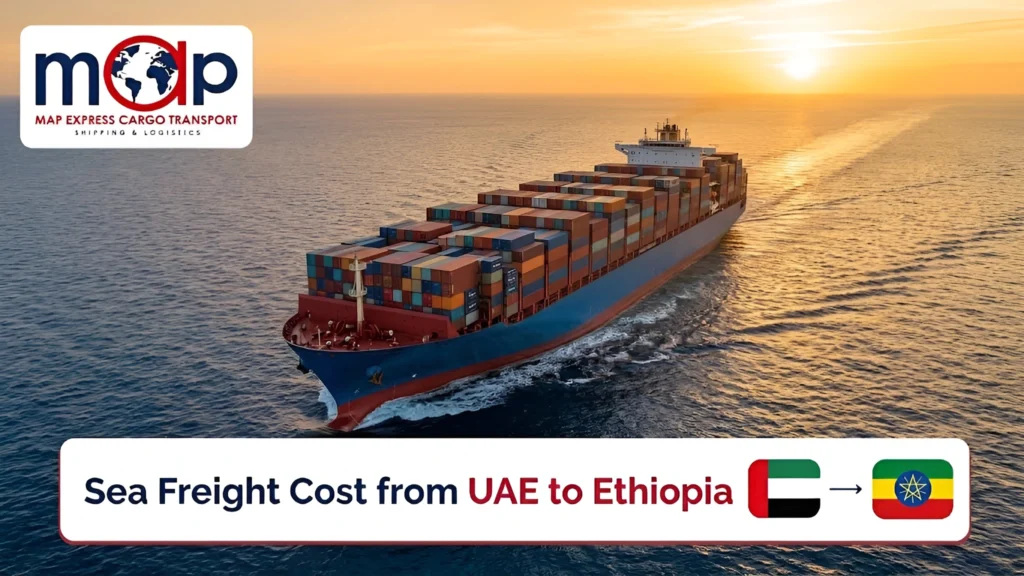
Sea Freight Cost from UAE to Ethiopia
Understanding sea freight costs from the UAE to Ethiopia is important when planning a commercial shipment, transporting equipment, or moving larger quantities of goods internationally. The total cost depends on more than the ocean freight rate. Container requirements, port charges, transit arrangements, customs procedures, and onward transportation can all influence the final amount.
Ethiopia is a landlocked country, so sea freight shipments generally arrive at a seaport in another country before continuing inland to their destination in Ethiopia. This means the selected port and the arrangements for onward transportation can have a significant effect on the overall shipping budget.
MapExpress Cargo provides logistics and freight forwarding solutions for different cargo requirements. In this guide, we explain the main factors that affect sea freight costs from the UAE to Ethiopia, how container options influence pricing, which additional charges to consider, and what information to prepare when requesting a quotation.
Looking for a Reliable Shipping Solution from the UAE?
MapExpress Cargo offers reliable air, sea, and land freight services for individuals and businesses, with support for customs procedures and international shipping requirements.
What Determines Sea Freight Costs from the UAE to Ethiopia?
There is no single price that applies to every shipment. Freight charges depend on the cargo, route, shipment size, and services included in the booking.
The main factors include:
Cargo weight, dimensions, and total volume.
Full Container Load (FCL) or Less than Container Load (LCL) requirements.
The collection location in the UAE and the selected departure port.
The arrival port serving the destination in Ethiopia.
Port handling and documentation charges.
Transit procedures and inland transportation.
Customs clearance responsibilities and applicable import charges.
Packaging, insurance, storage, and special handling where required.
A useful quotation should explain which costs are included and which may be charged separately. Comparing only the ocean freight rate may not provide an accurate picture of the total shipping expense.
FCL vs. LCL: How Container Choice Affects Cost
The container arrangement is one of the main decisions when estimating sea freight costs.
Full Container Load (FCL)
Full Container Load shipping involves reserving a dedicated container for a shipment. It may be suitable for larger commercial consignments, machinery, substantial household shipments, or cargo that requires dedicated container space.
FCL costs can depend on:
The container type and size.
The selected shipping route.
Cargo weight and any applicable weight restrictions.
Container availability and sailing arrangements.
Port handling and documentation.
Inland transportation and delivery requirements.
FCL may be appropriate when the shipment occupies enough space to justify a dedicated container or when the cargo requires a particular loading arrangement. However, it is not automatically the least expensive option for every shipment.
Less than Container Load (LCL)
Less than Container Load shipping allows eligible cargo to share container space with shipments belonging to other customers.
LCL may suit smaller consignments that do not require a full container. Charges may be based on shipment volume, weight, minimum billing rules, and handling requirements.
Potential cost considerations include:
Cargo measurement and consolidation charges.
Origin handling and documentation.
Destination deconsolidation and handling.
Minimum charges that may apply to small shipments.
Additional arrangements for inland delivery.
LCL can reduce the need to pay for an entire container, but the total cost should include the handling and delivery stages associated with the selected service.
Which Option Should You Choose?
The right choice depends on the shipment’s dimensions, weight, cargo type, budget, and delivery requirements. Request quotations for the available options when the shipment size makes either arrangement practical.
How Port Routing Affects Sea Freight Costs to Ethiopia
Because Ethiopia has no coastline, shipments generally need to pass through a seaport outside the country before moving inland.
The selected port and route affect the ocean freight rate as well as the costs associated with transit and onward transportation.
Port of Djibouti
The Port of Djibouti is an important maritime gateway for Ethiopian trade. Depending on the shipment and current service arrangements, cargo may arrive there before continuing to Ethiopia by road or another suitable inland transport arrangement.
The total cost may include ocean freight, port handling, applicable transit procedures, and inland transportation.
Other Potential Routing Options
Alternative regional gateways may be considered in certain circumstances, depending on current route availability, commercial arrangements, cargo requirements, and transit rules.
A different port does not necessarily mean a lower total cost. The ocean freight rate must be assessed alongside inland distance, handling charges, transit requirements, and delivery arrangements.
Questions to Ask About the Route
Before confirming a booking, ask the freight forwarder to identify:
The proposed departure port in the UAE.
The intended arrival port.
Whether transshipment is involved.
The planned transit arrangement into Ethiopia.
Whether inland transportation is included.
Which port, transit, and destination charges are excluded.
This information helps you compare quotations on a like-for-like basis.
Port Charges and Handling Fees
Port-related charges can form a significant part of the total logistics cost. The exact fees depend on the port, carrier, cargo, container arrangement, and service provider.
Possible charges include:
Terminal handling.
Loading or unloading-related services.
Documentation and administrative fees.
Container handling or equipment-related charges.
Cargo consolidation or deconsolidation for LCL shipments.
Storage if cargo remains at a facility beyond the applicable free period.
Inspection or other handling charges when required.
Not every charge applies to every shipment. Ask for a breakdown of the origin and destination charges and confirm whether any fees are estimates or subject to change.
Also check how long the cargo or container can remain at the port or facility before storage, demurrage, detention, or other time-related charges may apply.
Inland Transportation Costs from the Port to Ethiopia
Ocean freight does not complete the journey for cargo destined for Ethiopia. After arrival at the selected regional port, the shipment generally needs to continue inland.
The cost of this stage depends on the destination, cargo dimensions and weight, vehicle requirements, transit procedures, and availability of transportation.
Factors That Influence Inland Freight Costs
Delivery destination: The cost of delivering to Addis Ababa may differ from delivery to another Ethiopian city or a more remote location.
Cargo type: Heavy machinery, oversized items, fragile goods, and cargo requiring special equipment may need a different transport arrangement.
Vehicle requirements: The shipment may require a particular truck, container chassis, loading equipment, or unloading arrangement.
Transit procedures: Required border formalities, transit documents, and other applicable charges can affect the overall cost.
Delivery conditions: Restricted access, limited unloading facilities, or additional handling requirements may increase the amount payable.
When requesting a quote, confirm whether inland transport to Ethiopia is included or whether the price covers only the sea freight and arrival port stages.
Customs Clearance, Duties, and Taxes
Customs-related costs should be considered separately from the basic freight charge.
A shipment may require export procedures in the UAE, transit formalities in another country, and import clearance in Ethiopia. Each stage can have different documentation requirements and costs.
Depending on the shipment, potential charges may include:
Customs brokerage or clearance service fees.
Applicable import duties and taxes.
Inspection or examination-related charges.
Product-specific permits or certificates.
Transit-related fees or administrative requirements.
Additional costs caused by incomplete documentation or delayed processing.
The actual charges depend on the goods, customs classification, declared value, importer status, and applicable regulations. Do not assume that personal-use goods, used items, or commercial cargo are automatically exempt from duties or taxes.
Before dispatch, confirm who is responsible for customs clearance at each stage and which charges are included in the quotation. The importer should verify the applicable Ethiopian import requirements for the specific goods.
Documentation Costs and Shipment Preparation
Preparing the correct documents helps reduce avoidable problems during export, transit, and import procedures.
Common documents may include:
Commercial invoice: Describes the goods and transaction details.
Packing list: Identifies packages, contents, quantities, weights, and dimensions.
Bill of lading: Provides key information about the ocean transportation.
Certificate of origin: May be required depending on the goods and applicable rules.
Customs declarations: Required for the relevant export, transit, and import procedures.
Permits or certificates: May be necessary for regulated or specialized products.
Some shipments may require additional documents or approvals. Fees for document preparation, amendments, certificates, or related services depend on the shipment and provider.
Incorrect cargo descriptions, inconsistent values, missing documents, or late changes can lead to additional administrative work and possible delays. Preparing accurate information before booking can help avoid unnecessary costs.
Other Factors That Can Increase Sea Freight Costs
In addition to container rates, port charges, and inland transportation, several other factors may affect the total amount.
Cargo Dimensions and Weight
Heavy or oversized cargo may require special handling, equipment, or a particular container arrangement. Accurate measurements help the freight forwarder assess the shipment correctly.
Packaging and Palletization
Suitable packaging protects cargo during sea and inland transportation. Depending on the goods, additional wrapping, crating, pallets, or securing materials may be needed.
Cargo Insurance
Insurance may be available to help protect against specified risks, subject to the policy terms, exclusions, and declared cargo value. Its cost depends on the coverage and shipment details.
Storage and Delays
Storage or time-related charges may apply if cargo or containers remain at a port or facility beyond the applicable free period. Delays can also affect onward transport arrangements.
Special Handling
Fragile, hazardous, temperature-sensitive, oversized, or otherwise regulated cargo may require additional arrangements. Confirm acceptance and requirements before requesting a final quotation.
Seasonal and Market Conditions
Freight rates and available capacity can change according to market conditions, carrier schedules, demand, and route availability. A quotation should be checked for its validity period and any conditions that could affect the final charges.
How to Request an Accurate Sea Freight Quote
The more complete the shipment information, the easier it is to assess suitable container options, routing, and the expected cost components.
Prepare the following details before contacting MapExpress Cargo:
Cargo description: Explain what is being shipped and whether it is commercial or personal cargo.
Quantity and packaging: State the number of cartons, pallets, crates, or other packages.
Dimensions and weight: Provide the dimensions of each package and the total weight.
Container preference: Indicate whether you need FCL or LCL if you already know the likely requirement.
Collection location: Provide the pickup location in the UAE or confirm whether the cargo will be delivered to a designated facility.
Destination: Specify the city and delivery address in Ethiopia, if known.
Special requirements: Identify fragile, heavy, oversized, or regulated items.
Required service scope: Clarify whether you need port-to-port transportation, inland delivery, or a door-to-door arrangement.
Documentation status: Mention any permits or certificates that may be required or already available.
Ask for an itemized quotation showing the ocean freight, origin charges, destination port charges, transit arrangements, inland transportation, and any customs-related services or exclusions.
How to Compare Sea Freight Quotations
The lowest advertised freight rate may not represent the lowest total cost.
When reviewing quotations, check the following:
Whether the quotations use the same container type or cargo volume.
Whether the departure and arrival ports are identical.
Whether transshipment or other routing arrangements differ.
Whether port handling and documentation fees are included.
Whether inland transportation to Ethiopia is covered.
Whether customs clearance, duties, and taxes are excluded.
Whether storage, inspections, and other additional charges may apply.
Whether the quoted schedule is an estimate and what stages it covers.
How long the quotation remains valid.
Comparing these details helps you understand the complete service and identify costs that may otherwise be overlooked.
Practical Ways to Manage Sea Freight Costs
Although not every charge can be controlled, careful planning can help you make informed decisions.
Measure cargo accurately: Correct dimensions and weight help prevent quotation adjustments.
Choose the appropriate container option: Compare FCL and LCL based on the shipment’s actual volume and handling needs.
Prepare documents early: Reduce the risk of delays caused by missing or inconsistent paperwork.
Use suitable packaging: Protect goods without adding unnecessary volume or weight.
Confirm the full route: Understand the port, transit arrangements, and onward transportation before booking.
Clarify destination charges: Request a breakdown instead of relying only on the ocean freight rate.
Coordinate delivery in advance: Confirm the receiving location, vehicle access, and unloading arrangements.
Check quotation validity: Freight rates and service availability can change, so confirm the terms before proceeding.
The best shipping arrangement balances total cost, cargo protection, service scope, and the delivery requirements of the shipment.